
Home

Back

Contents

Next
Home |
Back |
Contents |
Next |
| Note: BeanShell 3.0 is not on Maven Central yet. To embed a 3.0 beta, put its JAR from GitHub releases in your classpath, or check out its tag and run mvn install to put it in your local Maven repository.
3.0.0b1 was built as org.beanshell:bsh; later 3.0
builds use io.github.beanshell, the groupId BeanShell
2.1.1 is published under on Maven Central.
|
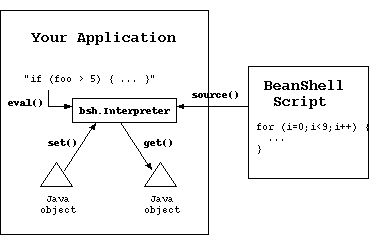
import bsh.Interpreter;

Interpreter i = new Interpreter();  // Construct an interpreter
i.set("foo", 5);                    // Set variables
i.set("date", new Date() );

Date date = (Date)i.get("date");    // retrieve a variable

// Eval a statement and get the result
i.eval("bar = foo*10");
System.out.println( i.get("bar") );

// Source an external script file
i.source("somefile.bsh");
|
| Tip: As of BeanShell 3.0 you can call interpreter.setOutputFile(path) to redirect
just that one interpreter's output and error streams to a
file, without touching System.out/System.err for the rest
of the JVM. The older static
Interpreter.redirectOutputToFile() still exists but,
despite its name, always redirects the JVM-wide system
streams; it is deprecated in favor of the new instance
method.
|
| Note: It is not necessary to add a trailing ";" semi-colon at the end of the evaluated string. BeanShell always adds one at the end of the string. |
Object result = i.eval( "long time = 42; new Date( time )" ); // Date
Object result = i.eval("2*2");  // Integer
|
reader = new FileReader("myscript.bsh");
i.eval( reader );
|
try {
    i.eval( script );
} catch ( EvalError e ) {
    // Error evaluating script
}
|
| String getErrorText() { |
| int getErrorLineNumber() { |
| String getErrorSourceFile() { |
try {
    i.eval( script );
} catch ( TargetError e ) {
    // The script threw an exception
    Throwable t = e.getTarget();
    print( "Script threw exception: " + t );
} catch ( ParseException e ) {
    // Parsing error
} catch ( EvalError e ) {
    // General Error evaluating script
}
|
i.source("myfile.bsh");
|
import bsh.Interpreter;
i=new Interpreter();

i.eval("myobject=object()" );
i.set("myobject.bar", 5);

i.eval("ar=new int[5]");
i.set("ar[0]", 5);

i.get("ar[0]");
|
// script the method globally
i.eval( "actionPerformed( e ) { print( e ); }");

// Get a reference to the script object (implementing the interface)
ActionListener scriptedHandler =
    (ActionListener)i.eval("return (ActionListener)this");

// Use the scripted event handler normally...
new JButton.addActionListener( scriptedHandler );
|
Interpreter interpreter = new Interpreter();
// define a method called run()
interpreter.eval("run() { ... }");

// Fetch a reference to the interpreter as a Runnable
Runnable runnable =
    (Runnable)interpreter.getInterface( Runnable.class );
The interface generated is an adapter (as are all interpreted interfaces).
It does not interfere with other uses of the global scope or other
references to it.
We should note also that the interpreter does *not* require that any or all
of the methods of the interface be defined at the time the interface is
generated. However if you attempt to invoke one that is not defined
you will get a runtime exception.
| Tip: You can clear all variables, methods, and imports from a scope using the clear() command. |
javax.script package),
instead of using the bsh.Interpreter class directly. BeanShell registers
itself as a script engine under the names "beanshell", "bsh" and "java",
and for the file extensions ".bsh" and ".java", so the standard
ScriptEngineManager will find it automatically as long as the BeanShell
JAR is on your classpath:
import javax.script.ScriptEngine;
import javax.script.ScriptEngineManager;

ScriptEngineManager manager = new ScriptEngineManager();
ScriptEngine engine = manager.getEngineByName("beanshell");

engine.put("foo", 5);
engine.eval("bar = foo * 10;");
System.out.println( engine.get("bar") );
|
| Note: If you would rather work directly against the interpreter (for example to use eval()'s return value or the get()/set() shortcuts described above) use the bsh.Interpreter class directly as described earlier in this section. The JSR223 engine is mainly useful when your application is already written against the generic javax.script API and you want to be able to swap scripting languages. |
| Note: There is serious Java bug that affects BeanShell serializability in Java versions prior to 1.3. When using these versions of Java the primitive type class identifiers cannot be de-serialized. See the FAQ for a workaround. |
// From BeanShell object.namespace.prune(); // From Java object.getNameSpace().prune(); |
// From BeanShell bind( object, this.namespace ); // From Java bsh.This.bind( object, namespace, interpreter ); |
Home |
Back |
Contents |
Next |